

Choosing a new hairstyle, pair of glasses, or grooming style can be surprisingly difficult. A look that works perfectly for one person may not create the same effect on another, even when their hair type and personal style are similar.
One reason is facial proportion.
Your face has a particular combination of length, width, cheekbone prominence, forehead size, and jaw structure. Understanding these proportions can give you a useful starting point when experimenting with your appearance.
This is where face shape analysis becomes helpful.
What Does Face Shape Actually Mean?
Face shape is a general way of describing the geometric proportions of the face.
Rather than focusing on individual features such as the nose or eyes, face shape looks at the overall relationship between different areas of the face.
The most common categories are:
- Oval
- Round
- Square
- Oblong
- Rectangle
- Heart
- Diamond
- Triangle
These categories aren’t strict scientific classifications. They are simplified descriptions that make it easier to discuss facial proportions and styling.
Your face can also have characteristics from two different categories. That’s completely normal.
The Four Measurements That Matter Most
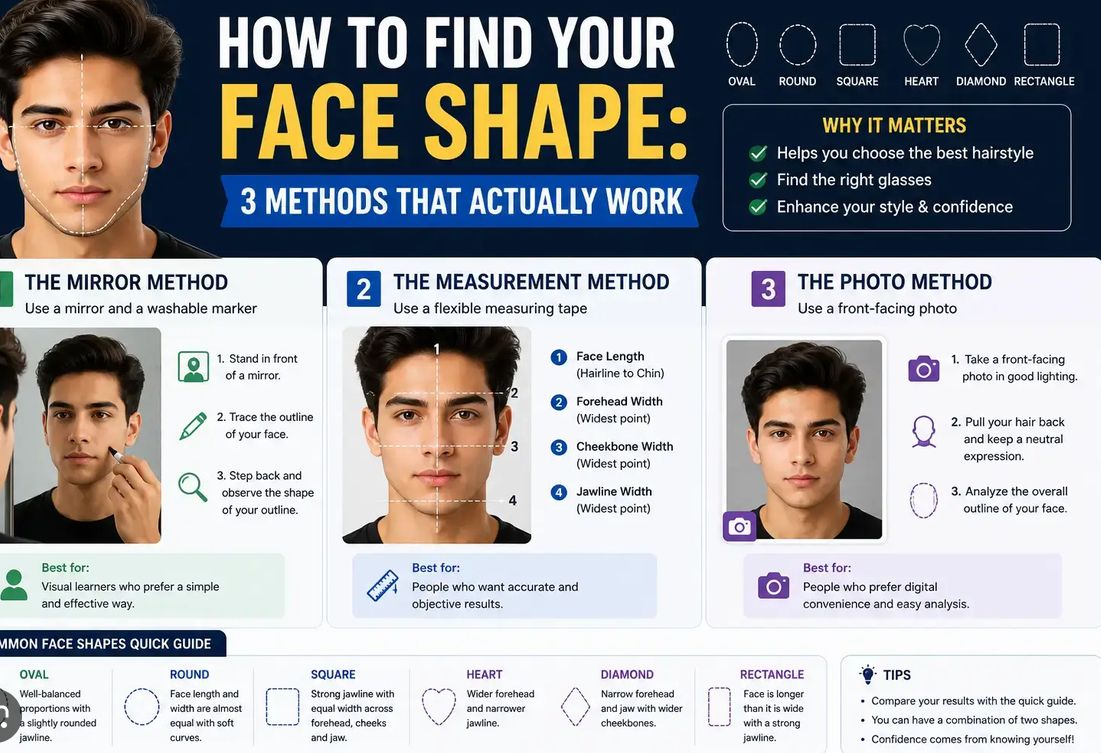
If you want to identify your face shape more objectively, four measurements are particularly useful.
Face Length
Face length measures the vertical distance from the upper forehead or hairline area to the bottom of the chin.
A face that is substantially longer than it is wide may fit into a longer face category, such as oval, oblong, or rectangle.
Forehead Width
Measure across the widest portion of the forehead.
The forehead becomes especially useful when comparing upper-face width with the cheekbones and jaw.
Cheekbone Width
The cheekbones often determine the widest point of the face.
A face with prominent cheekbones and noticeably narrower forehead and jaw proportions may have characteristics associated with a diamond shape.
Jaw Width
The jaw measurement helps complete the proportion comparison.
However, width isn’t the only consideration. The shape of the jawline—whether it is rounded, tapered, or angular—can also influence the final classification.
How to Identify Your Face Shape Without Guessing
A mirror can give you an initial idea, but visual judgment can be misleading.
Instead, start by looking at the relationship between your measurements.
If your face is longer than it is wide and gradually narrows toward the chin, an oval or oblong classification may be worth considering.
If your face has similar length and width with a softer outline, round may be a possibility.
If the jaw and forehead appear broad and the jaw has strong corners, square may be a better match.
If your upper face is wider and the lower face becomes noticeably narrower, heart-shaped proportions may be present.
The key is to compare multiple characteristics instead of relying on one feature.
Try a Face Shape Detector
If manually comparing measurements sounds tedious, a photo-based tool can provide a faster starting point.
A free face shape detector can analyze a front-facing image or camera input and compare facial proportions across eight common face shape categories.
The detector can also work with manually entered measurements, allowing you to approach the analysis in different ways.
For the most useful photo result, make sure your face is clearly visible and avoid conditions that can distort the apparent proportions.
How to Take a Better Photo for Face Analysis
A face shape tool can only work with the information visible in the image, so the photograph matters.
Follow these simple guidelines:
- Keep your head straight rather than turning it sideways.
- Keep your chin level.
- Pull long hair away from your face.
- Remove glasses if they cover important facial areas.
- Use a neutral facial expression.
- Choose relatively even lighting.
- Avoid heavy filters or beauty effects.
- Don’t hold the camera extremely close to your face.
A very close smartphone selfie can make the center of the face appear larger because of lens and perspective effects.
A more natural camera distance generally provides a better representation of your proportions.
Manual Measurement Is Another Option
Not everyone wants to use a camera.
If you prefer a measurement-based approach, you can record your face length, forehead width, cheekbone width, and jaw width yourself.
Use the same unit for every measurement. For example, if you start in centimeters, keep all four measurements in centimeters.
You can then enter those values into a face shape calculator to compare the proportions.
Manual measurement has one important advantage: you control exactly where each measurement begins and ends.
Understanding Each Face Shape
Oval
Oval faces are generally longer than they are wide. The cheekbones often provide much of the width, while the jaw gradually tapers.
Because the proportions tend to be balanced, oval is frequently used as a reference category in styling discussions.
Round
Round faces tend to have relatively similar length and width, combined with a softer, curved outline.
The cheeks can appear prominent, and there are usually fewer pronounced angular transitions around the jaw.
Square
Square faces commonly have a strong, angular jaw and relatively similar widths across the forehead, cheekbones, and jaw.
The overall outline tends to look structured rather than rounded.
Oblong
Oblong faces are noticeably longer than they are wide, while the jaw tends to have a softer contour.
The overall impression is one of vertical length without the pronounced angularity associated with some rectangular face shapes.
Rectangle
Rectangle faces combine noticeable facial length with a stronger, more angular jaw.
They can therefore share characteristics with both oblong and square categories.
Heart
Heart-shaped faces typically have a wider upper face and a narrower lower face.
The forehead can be relatively broad while the chin becomes more tapered.
Diamond
Diamond-shaped faces tend to have prominent cheekbones with narrower forehead and jaw areas.
The combination creates a more noticeable width through the middle of the face.
Triangle
Triangle-shaped faces are generally wider toward the jaw than the forehead.
The lower part of the face therefore becomes the dominant area when comparing overall width.
Why Your Face Shape Result Might Change
Don’t be surprised if different tests give you slightly different answers.
There is no universally accepted formula for assigning every person to exactly one face shape.
Different tools can use different thresholds and measurement points. A small change in the location of your cheekbone or jaw measurement can affect the proportions.
Photos introduce additional variables, including:
- Camera distance
- Lens characteristics
- Head position
- Lighting
- Facial expression
- Hair placement
- Glasses or accessories
For this reason, a face shape result should be viewed as an estimate rather than a permanent label.
What If You Have Two Face Shapes?
Many people don’t fit perfectly into one category.
You might have a relatively long face but a strong square jaw. Or you might have prominent cheekbones combined with proportions that are closer to oval.
Instead of worrying about which label is technically correct, consider the characteristics you actually have.
For styling purposes, those characteristics can be more useful than the name of the category.
Using Face Shape for Hairstyle Decisions
Face shape can be one factor when choosing a hairstyle.
Someone with a longer face might experiment with styles that create more visual width rather than adding excessive height.
Someone with a rounder face may prefer styles that introduce some vertical structure.
For a square face, you can choose whether to emphasize the angular jaw with a structured look or soften the appearance with texture.
But face shape shouldn’t be the only consideration. Hair density, texture, curl pattern, hairline, lifestyle, and maintenance preferences are equally important.
Face Shape and Eyewear
Glasses are another area where facial proportions can be useful.
Instead of simply following a rule such as “round faces need square glasses,” consider the actual dimensions of the frame.
Frame width, lens height, bridge position, and how the glasses sit on your face all affect the final appearance.
A frame that technically suits your face shape can still look wrong if it doesn’t fit properly.
Don’t Turn Face Shape Into an Attractiveness Score
It’s important to keep face shape analysis in perspective.
There is no universally superior face shape.
Face shape is simply a description of geometry. It does not measure attractiveness, personality, health, or overall appearance.
The same face shape can look completely different depending on hairstyle, expression, grooming, makeup, lighting, and individual facial features.
Use face shape information as a styling tool rather than a judgment.
A Simple Method to Get Started
If you’re curious about your own face shape, you don’t need an elaborate process.
Start with a clear front-facing photo and make sure your face is unobstructed. Then compare your facial length with its width and identify which area is widest.
If the result isn’t obvious, take four measurements: face length, forehead width, cheekbone width, and jaw width.
Finally, compare those proportions using a face shape detector or calculator.
This approach gives you considerably more information than simply looking at a face shape chart and choosing whichever image seems closest.
Final Takeaway
Face shape is essentially about proportions.
By comparing facial length, forehead width, cheekbone width, jaw width, and jaw contour, you can develop a much clearer idea of your general face shape.
Whether your result is oval, round, square, oblong, rectangle, heart, diamond, or triangle, remember that these categories are guidelines rather than rigid definitions.
Once you understand your proportions, you can use them as one of several factors when experimenting with hairstyles, eyewear, grooming, and personal style.
The most useful face shape analysis isn’t the one that gives you a label the fastest. It’s the one that helps you understand the proportions behind that label
