

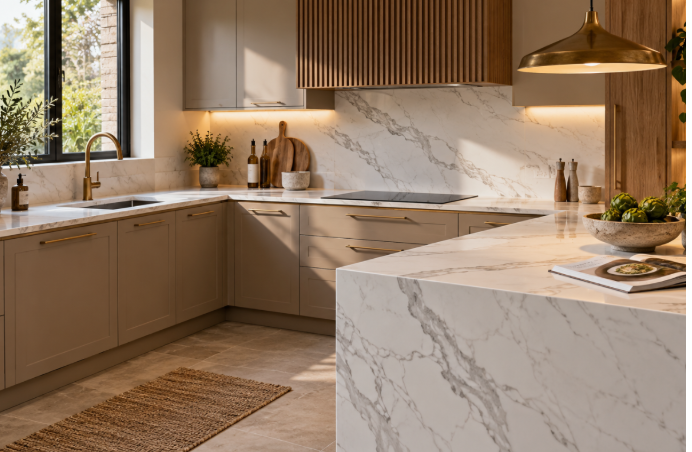
Marble has long been associated with elegant kitchens because of its distinctive veining, natural variation, and timeless appearance. However, natural marble also requires careful maintenance and can be vulnerable to staining and etching. Quartz offers an alternative that can recreate many of the visual characteristics of marble while providing the practical qualities expected from a modern work surface.
For homeowners planning a kitchen renovation, a marble effect quartz worktop can combine a classic stone-inspired appearance with the consistency and everyday practicality of engineered quartz. Understanding the available patterns, finishes, colours, and practical considerations can make it easier to choose a surface that works with the rest of the kitchen.
What Is Marble Effect Quartz?
Marble effect quartz worktop is an engineered worktop material designed to reproduce the appearance of natural marble. Quartz surfaces are manufactured using a mixture of quartz minerals and other materials, with pigments and patterns used to create different visual effects.
Unlike natural marble, where veining develops naturally within the stone, engineered quartz can be designed with more controlled patterns. This allows manufacturers to produce surfaces featuring subtle lines, dramatic veins, or softer tonal variations.
The result can provide the visual character associated with marble while offering a more consistent appearance across different slabs.
Understanding Veining and Colour
One of the most important design features is the type of veining used across the surface. Marble effect quartz worktop, understated veins, while others feature strong patterns designed to become a focal point.
Colour also affects how the worktop interacts with the wider kitchen. White and light-coloured surfaces can contribute to a bright appearance, while grey or warmer undertones may create a softer, more traditional look.
When selecting a worktop, it is useful to consider cabinet colours, flooring, splashbacks, wall finishes, and appliances together rather than choosing the worktop in isolation.
Why Quartz Is Suitable for Busy Kitchens
Kitchen worktops need to cope with regular preparation, cooking, cleaning, and general household activity. Quartz is a popular engineered surface because it provides a hard, durable worktop for everyday use.
Its non-porous characteristics can also make routine cleaning straightforward. Spills should still be cleaned promptly, particularly around areas where food, oils, or strongly coloured ingredients are regularly used.
As with any worktop material, the manufacturer’s care instructions should be followed because finishes and technical specifications can differ between products.
Marble Effect Quartz vs Natural Marble
The choice between quartz and natural marble often comes down to priorities involving appearance, maintenance, and consistency.
Natural marble has unique veining and geological variation, meaning every slab can have its own character. Quartz can provide a more predictable design, which can be helpful when homeowners want a particular colour or pattern.
Marble is also susceptible to etching from acidic substances and generally requires more consideration when it comes to maintenance. Quartz can offer a lower-maintenance alternative, although it is not completely maintenance-free and should still be treated according to manufacturer recommendations.
Consider the Worktop Layout
The size and layout of a kitchen can influence how a patterned quartz surface looks once installed. Larger islands, peninsulas, and long runs of worktop may display more of the veining, making slab positioning an important design consideration.
For more pronounced marble patterns, homeowners may want to discuss vein direction and joins with the fabricator before installation. Planning the slab layout can help ensure that visible areas of the worktop achieve the intended appearance.
Cut-outs for sinks and hobs should also be considered during the planning stage.
Choosing the Right Edge Profile
The edge profile can subtly change the character of a quartz worktop. A simple square edge can complement contemporary kitchens, while a more detailed profile may suit a traditional interior.
The choice should consider both appearance and practicality. Corners and edges should be properly fabricated and finished by an experienced professional to achieve a clean result.
Cleaning and Maintaining Quartz
Regular cleaning generally requires little more than appropriate cleaning products and a soft cloth, depending on the manufacturer’s recommendations.
Abrasive cleaners, harsh chemicals, and unsuitable tools may damage the surface or affect its finish. Hot cookware should also be handled according to the manufacturer’s instructions, as quartz surfaces can be affected by extreme heat.
Using chopping boards and suitable trivets can provide additional protection during everyday kitchen use.
Planning Your Investment
A worktop is a significant part of a kitchen, so homeowners should consider more than the initial material price. Measurements, fabrication, cut-outs, edge details, delivery, and installation can all affect the overall project cost.
It is also worth requesting samples where possible. A quartz surface can look different under natural daylight, artificial lighting, and alongside different cabinet colours.
Conclusion
A marble-inspired worktop can bring the visual elegance of natural stone into a modern kitchen without requiring homeowners to choose actual marble. Quartz provides a combination of design flexibility, durability, and relatively straightforward maintenance that suits many busy households. Exploring options such as a Rougui quartz worktop can also help homeowners compare different styles and find a surface that complements their kitchen design. Before making a final decision, compare colours, veining, finishes, slab layouts, maintenance requirements, and installation details.
